
The Marvellous as Lived: Rethinking the Real in Twentieth-Century Mexican Art
Author: Sophie Becquet, McGill University
Editors: Dahlia Labatte and Ayşegül Alpak
Introduction
European movements such as Surrealism and Primitivism often sought the marvellous through invention, constructing dreamlike images or idealizing the “exotic” Other. In the Americas, however, the marvellous has often been understood as emerging from lived experience rather than artistic fabrication. It was this distinction that led the Cuban writer Alejo Carpentier, in 1949, to articulate lo real maravilloso—the marvellous real—as a way of describing a reality in which “everything strange, everything amazing, everything that eludes established norms is marvelous,” and where the extraordinary is embedded within the everyday.[1] I argue that a lived sense of the extraordinary, rather than fantasy or metaphor, structures selected works of Mexican modernism and visual devotional practices. Reading these works through a critically applied notion of lo real maravilloso shows how Mexican artists and devotional makers envisioned the marvellous as part of life, not an escape from it.
Rather than adopting Carpentier’s marvellous real as a fixed framework, I take it as a historical and conceptual point of entry, a way to ask how the “marvellous” has been imagined, lived, and represented in twentieth-century Mexican art. Whereas Carpentier wrote as if there were one marvellous real for “the Americas,” I use his concept to validate worlds in the plural. This approach recognizes how diverse ontologies and histories unsettle the singular view his concept implies. Carpentier revealed how wonder could be part of reality, yet his understanding remained largely metaphorical and criollo (reflecting the worldview of Latin America’s European-descendant elites). Following the ontological turn in anthropology, I argue that the marvellous real can be understood as a lived relation between coexisting worlds that art makes visible. Focusing on the work of Mexican modernist painters Frida Kahlo and María Izquierdo, read in conversation with retablo ex-votos—small votive paintings on tin—I demonstrate that artists across different contexts visualized worlds in which the marvellous and the real coexist.
Focusing on Mexico allows for a closer look at how these realities took visual form within a society shaped by colonial legacies and cultural entanglements. Although Carpentier described the marvellous real as unique to the “Americas,” his examples largely concern Latin America. Mexico offers a compelling case: its history of cultural and religious syncretism has shaped visual and spiritual languages through which the ordinary and extraordinary often appear intertwined. At the same time, Mexico’s dialogue with European art worlds makes it an ideal site for examining how external frameworks have defined and often distorted understandings of Mexican modernism.
Methodologically, I bring an anthropological orientation informed by the ontological turn into dialogue with close visual analysis. Rather than treating cultures as different perspectives on one shared world, I follow thinkers such as Viveiros de Castro in taking seriously the possibility that they constitute different worlds, and I approach artworks as one of the ways those worlds become perceptible. Situating this approach requires turning to Alejo Carpentier, whose formulation of lo real maravilloso grew out of an effort to name a distinctly Latin American mode of being. His writings serve as an earlier attempt to distinguish the marvellous real from European aesthetic categories such as Surrealism, and they provide a historical and conceptual starting point for rethinking how Latin American art has been interpreted.
Alejo Carpentier and the Marvellous Real
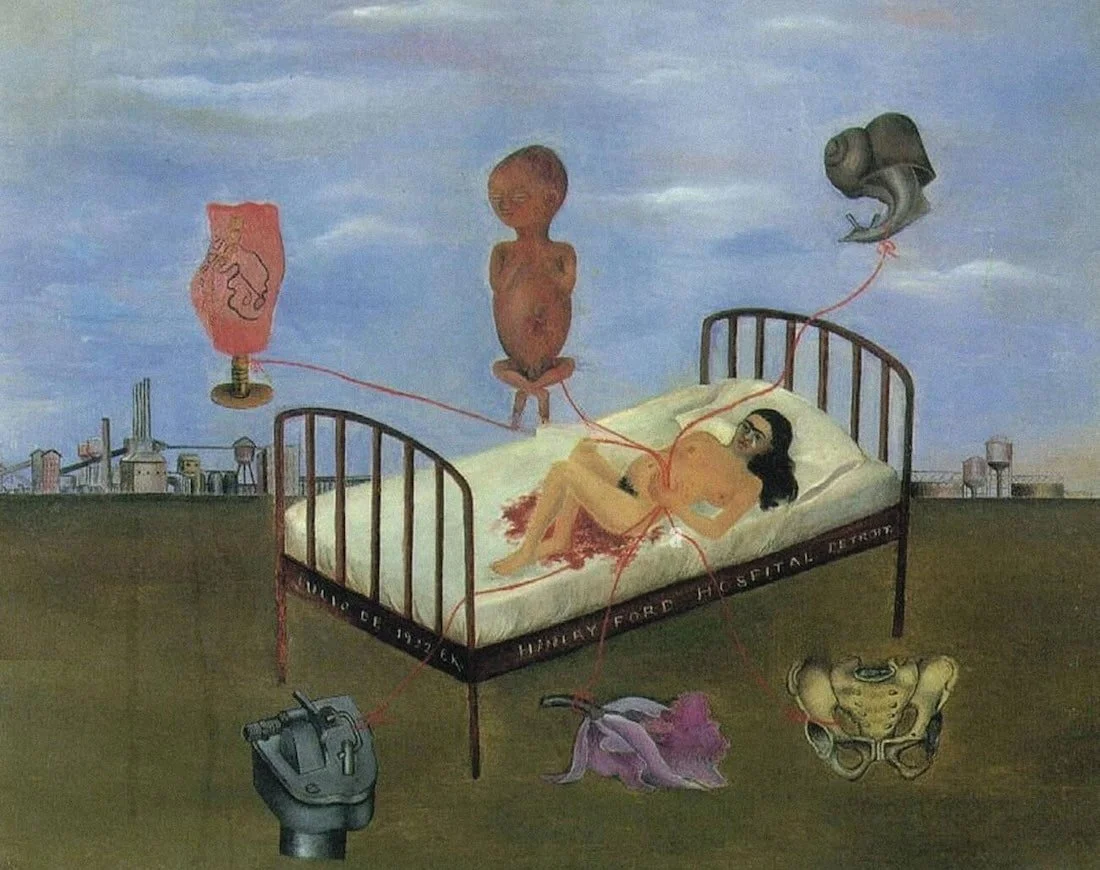
Fig. 1. Frida Kahlo, Henry Ford Hospital, 1932. Oil on metal, 30.5 × 38 cm. Museo Dolores Olmedo, Xochimilco, Mexico City.
Alejo Carpentier first articulated the concept of lo real maravilloso in the prologue to his novel El reino de este mundo (The Kingdom of This World) in 1949.[2] Written following his 1943 visit to Haiti, the text recounts his experience of a landscape and history so deeply infused with faith, myth, and revolution that he felt that the marvellous emerged as part of everyday life. Standing before the ruins of Henri Christophe’s kingdom, Carpentier realized that what European artists sought through Surrealism already existed, tangibly and profoundly, in the Americas.[3] For him, the Haitian revolutionary François Mackandal, believed by thousands to take animal form, embodied this principle: collective belief itself made the miracle real.[4] Carpentier contrasted this lived marvellous with what he saw as the contrived Surrealist pursuit of wonder. He dismissed arbitrary combinations such as “the fortuitous encounter of the umbrella and the sewing machine on an operating table,” calling its practitioners “bureaucrats” of the marvellous who produced wonder by arrangement rather than conviction.[5] For him, “the marvelous begins to be marvelous in an unequivocal way when it arises from an unexpected alteration of reality (a miracle), from a privileged revelation of reality, from an illumination that is either unusual or singularly favorable to the unnoticed riches of reality, from an amplification of the scale and categories of reality perceived.”[6] He also insists that “the phenomenon of the marvelous presupposes a faith.”[7] This idea is central to his vision, though my approach broadens it: I understand realities as true through their effects in the world, whether or not faith is involved. He came to view the Americas as charged with the marvellous, a place where ordinary life carried the weight of myth and faith. “What is the history of all the Americas,” he concluded, “but a chronicle of the marvelous real?”[8]
In his essay “On the Marvelous Real in America,” Carpentier developed these ideas into a more systematic theory. He described the marvellous real as “an amplification of perceived reality required by and inherent in Latin American nature and culture.”[9] In doing so, he emphasized that the marvellous enlarges one’s perception of the real. “In Latin America,” he wrote, “the fantastic is not to be discovered by subverting or transcending reality with abstract forms and manufactured combinations of images. Rather, the fantastic inheres in the natural and human realities of time and place.”[10] The marvellous thus emerges not from manipulation but from attention to the richness of life.
More than two decades later, in “The Baroque and the Marvelous Real,” Carpentier linked the marvellous real to the Baroque, which he understood not as a historical style but as a recurring creative principle of hybridity and transformation.[11] Drawing on writer Eugenio d’Ors, he described the Baroque as “a human constant… a spirit and not a historical style.”[12] In this way, the marvellous real gives content to the Baroque, while the Baroque gives the marvellous real its expressive form.
The task of defining a Latin American sensibility no longer measured by European standards has long been entangled with questions of power and representation. This is addressed in philosopher Walter Mignolo’s Local Histories/Global Designs: Coloniality, Subaltern Knowledges, and Border Thinking, where he develops the idea of “border thinking.”[13] Mignolo describes it as a way of thinking from the border rather than about it, a perspective that emerges from the colonial difference and seeks to delink from the universal claims of Western modernity. As he writes, “the bottom line is not to confuse thinking about borders while dwelling in disciplinary territorialities with border thinking that emerges from dwelling in the border and delinks from disciplinary territorialities.”[14] It is a stance that values knowledge formed in the spaces that modernity once defined as peripheral. Seen through this lens, Carpentier’s marvellous real is both resistant and constrained: he wanted to define a mode of being rooted in the Americas, yet he did so through concepts that remained tied to European ways of seeing.
Later critics connected Carpentier’s ideas to the broader genealogy of magical realism, a term that originated in German art critic Franz Roh’s magischer realismus in 1925 and evolved across art and literature to describe modes in which magical occurrences are accepted as normal.[15] Lois Parkinson Zamora and Wendy B. Faris, in their edited volume Magical Realism: Theory, History, Community, frame the genre as one in which “the supernatural is not a simple or obvious matter, but it is an ordinary matter, an everyday occurrence—admitted, accepted, and integrated into the rationality and materiality of literary realism.”[16] Their account shows how magical realism uses fiction to address social and historical conditions through ontological disruption.[17] Yet that disruption works by constructing narrative worlds where the marvellous can operate. By contrast, I use the marvellous real to read the marvellous as already part of lived reality.
Art Historical Categories and Their Limits
While abandoning art-historical categories altogether is not my aim here, their application requires scrutiny. Terms such as “Surrealism,” “Primitivism,” and “folk art” emerged within particular European intellectual traditions, each carrying assumptions about modernity, progress, and the boundaries of the “real.” When used to describe Mexican art, these categories can obscure the realities from which the works arise, positioning artists as participants in a European story rather than as theorists of their own worlds. I do not intend to dismiss these categories but to examine their limits and show how, reinterpreted through an ontological framework, the marvellous real can offer a more holistic understanding that restores agency to artists and recognizes the grounding of their work in lived experience.
These art historical categories took different forms but shared a common logic. Each positioned Mexican art in relation to Europe rather than within its own historical continuum. Surrealism offers a clear example, since it explicitly sought to align Mexico with a European avant-garde movement devoted to the marvellous. This association both revealed and obscured what Carpentier had described as the marvellous real.
Surrealism’s arrival in Mexico in the late 1930s coincided with a growing fascination among European intellectuals with the “exotic” and the “primitive.” When French writer André Breton visited in 1938, he declared Mexico “the Surrealist place par excellence.”[18] For Breton, the country’s culture and landscapes seemed to embody the dreamlike spontaneity that Surrealism pursued through imagination. Yet this projection reflected Europe’s own desires more than Mexico’s realities. What Surrealism sought through the unconscious, Mexico experienced through lived experience. As Frida Kahlo’s biographer Hayden Herrera observes, “The self-conscious search for subconscious truths that may have provided European Surrealists with some release from the confines of the rational world and ordinary bourgeois life offered little enchantment in a country where reality and dreams are perceived to merge and miracles are thought to be daily occurrences.”[19] What Breton recognized as Surrealism was, in fact, the ordinary occurrences within a world where the marvellous and the real were already inseparable.
Frida Kahlo’s reception in Europe illustrates this tension. When Breton encountered her work, he praised it as evidence that Surrealism transcended geography. “My surprise and joy were unbounded,” he wrote, “when I discovered… her work had blossomed forth… into pure surreality, despite the fact that it had been conceived without any prior knowledge whatsoever of the ideas motivating the activities of my friends and myself.”[20] What Breton understood as a validation of Surrealism’s reach, however, reveals a deeper misreading. By interpreting Kahlo’s imagery through his own theoretical concepts, he claimed her work for a movement that had little to do with the world she depicted. For Kahlo, painting was not a way of escaping reality but of rendering it visible in all its complexity. Kahlo’s own words, “They thought I was a Surrealist, but I wasn’t. I never painted dreams. I painted my own reality,” clarify her divergence from Surrealism’s effort to find the marvellous in the workings of the mind rather than in lived experience.[21]
This difference between Surrealist fantasy and Kahlo’s “own reality” becomes clear in her painting Henry Ford Hospital (fig. 1).[22] The work shows Kahlo lying naked on a hospital bed, blood pooling beneath her body, her abdomen pierced by a red vein that stretches outward to six floating objects: a fetus, a snail, a pelvis, a machine part, a male torso, and an orchid. Each object is rendered with a clear, frontal isolation, suspended against the expansive landscape. The metal bedframe, bearing the words “Henry Ford Hospital” on one side and “June of 1932” on the other, anchors the composition in a specific place and moment, while the floating objects externalize her physical and psychic trauma. Kahlo’s small body is dwarfed by the vast industrial landscape of Detroit, creating a confrontation between the intimately human and the mechanically modern. The image functions less as a dream than as a painted testimony of miscarriage and pain. Through this stark, direct language, Kahlo redefines the marvellous real as something grounded in the body and its persistence.
While Surrealism often misread Mexico as a landscape of dreams, Primitivism portrayed it as a living remnant of the past. Both frameworks positioned Mexican modernism as distant from Europe, whether in psychological or temporal terms. As anthropologist Johannes Fabian argues in Time and the Other: How Anthropology Makes its Object, anthropology has long depended on a paradox: it insists on direct and sustained engagement with other peoples, yet transforms the immediacy of that encounter into discourse that renders the Other distant, abstract, and outside the present, so that “the Other’s empirical presence turns into his theoretical absence… through devices that keep the Other outside the Time of anthropology.”[23] To explain this process, Fabian coined the term “denial of coevalness,” describing “a persistent and systematic tendency to place the referent(s) of anthropology in a Time other than the present of the producer of anthropological discourse.”[24]
Fabian’s critique of ethnographic time also exposes the logic that underpinned modernist Primitivism. Just as anthropology constructed the “primitive” as existing in another temporal order, so too did art history locate the value of certain cultures in their supposed anteriority. “Temporalizations expressed as passage from savagery to civilization, from peasant to industrial society,” Fabian writes, “have long served an ideology whose ultimate purpose has been to justify the procurement of commodities for our markets.… Something analogous happens with ‘primitive art.’”[25] In both anthropology and art history, creative work was often reclassified as data or “evidence,” detached from its living contexts and absorbed into narratives of Western progress. Fabian identifies this distancing most vividly in the persistent trope of the “childlike native,” which “informed colonial practice in every aspect… from religious indoctrination to labour laws and the granting of basic political rights.”[26] This same rhetoric of innocence and instinct shaped the reception of artists like María Izquierdo.
Primitivism in art worked through this logic of temporal separation. It treated Mexican creators not as participants in modernity but as vestiges of an earlier stage of humanity, valued for their supposed purity and simplicity. Mexican modernism was often described in these terms, its originality explained through proximity to a collective, ancestral past rather than through the conscious work of its artists.
María Izquierdo’s critical reception demonstrates how this hierarchy operated through race. Critics and writers frequently described her as “naïve” or “primitive,” as if her mestiza ancestry automatically guaranteed a sort of authenticity.[27] French artist Antonin Artaud, who traveled to Mexico in search of what he imagined as a “primitive culture with a magical spirit,” claimed that Izquierdo painted by “reaching into the well of her racial unconsciousness,” and that “the spirit of the Indian race speaks so strongly in her that, even unconsciously, she repeats its voice.”[28] Although intended as praise, these comments presented her as a passive conduit for racial essence rather than an active artist. Izquierdo was portrayed as intuitive and spontaneous, her creativity explained through biology and ancestry rather than through thought or intention.
Izquierdo herself saw her practice differently. She wrote of striving for “technical perfection (without descending into cold virtuosity)” and for the “mysterious poetry of [her] country,” seeking to express lo mexicano through carefully composed themes that joined the emotional and the formal.[29] As art historian Elizabeth Ferrer notes, her “slightly awkward” drawing style was not childlike; rather, she “consciously converted awkwardness into expressiveness.”[30] To label Izquierdo as “primitive” or “naïve” was to deny her coevalness, to situate her work in a symbolic past that made it seem timeless but also intellectually marginal. The same language that critics used for her reappeared in institutional discussions of folk art. These categories extended the logic of Primitivism, distinguishing between art seen as intellectual and modern, and art framed as spontaneous and traditional.
The 1940 exhibition Twenty Centuries of Mexican Art at the Museum of Modern Art reflects how this language of “naïveté,” racial essence, and temporal distance became institutionalized. The catalogue describes the retablo painter as one who “interprets the scene of divine intervention with primitive ingenuity and charm and deep religious faith. Ignoring the laws of perspective, he represents the characters, the place, and the event with a direct and naïve simplicity, frequently achieving small masterpieces in colour, composition, and dramatic feeling.”[31] It concludes that “our great modern painters have found in these ‘retablos’ one of the authentic expressions of Mexican painting.”[32] On the surface, such language expresses admiration for the sincerity and inventiveness of Mexican folk art, yet it also relies on a rhetoric of authenticity that equates truth with simplicity and faith with artistic purity. By defining retablos as “authentic,” the text positions them as untouched by modernity and as repositories of a collective essence rather than products of individual intention. The exhibition sought to honour Mexico’s creative traditions, yet its framing reinscribed the same temporal logic that shaped the reception of modern artists like Izquierdo. What appeared as cultural reverence was, in effect, another iteration of Fabian’s denial of coevalness, presenting folk artas alive yet outside history.
While the categories of “folk” and “fine” art warrant critique, my aim is not to collapse them altogether. Doing so would risk repeating the very homogenizing gestures I question. As art historian Layla Bermeo observes in her book Frida Kahlo and Arte Popular, André Breton’s Mexique exhibition “homogenized Mexican culture and situated wooden skeletons and ceramic animals as the equivalent of Kahlo’s art, rather than the inspiration behind it.”[33] My approach differs in that I seek not to equate devotional and modernist art production, but to examine how both participate in related ways of perceiving and representing the marvellous real. This tension between admiration and distinction was also felt by Mexican artists themselves. As Bermeo notes, “The descriptions of los Judas by Modern artists—both in their words and in their work—reveal a tension between the desire for arte popular to be totally quotidian and the insistence that such objects be regarded as high art.”[34] Kahlo in particular admired arte popular—Mexican folk art—but resisted being classified within it, writing before her 1939 Paris exhibition that although she valued arte popular, she did not consider herself a folk artist.[35] Acknowledging this complexity allows for a more careful use of the marvellous real, not as a framework that erases artistic and social distinctions, but as one that recognizes how different forms of making can express realities. This ambivalence of feeling both connected to and distinct from arte popular mirrors, in subtle form, the very dynamic that defined Europe’s relation to Mexico: a simultaneous fascination with and distancing from what was perceived as the Other. In this sense, Mexican modernism inherited and reconfigured the same tension it sought to escape, translating it into a dialogue between forms of artistic expression.
Anthropological Framework
To move beyond inherited hierarchies, it is necessary to turn briefly to anthropology, whose evolving methods of understanding difference offer a productive way to rethink such divides. The ontological turn in anthropology, developed in the early twenty-first century through thinkers such as Bruno Latour, Philippe Descola, and Eduardo Viveiros de Castro, moved away from earlier interpretive approaches that treated cultures as holding different perspectives on a shared world. As outlined in The Ontological Turn: An Anthropological Exposition, this movement proposes that people may inhabit distinct realities altogether. In the book, anthropologist Viveiros de Castro’s account of Amerindian perspectivism illustrates this shift: the differences between beings are not merely differences in worldview but differences in the worlds they inhabit—“not a plurality of views of a single world, but a single view of different worlds.”[36] This distinction replaces the modern assumption of multiculturalism (many cultures, one nature) with what he calls multinaturalism (one culture, many natures). As anthropologists Martin Holbraad and Morten Axel Pedersen write in the introduction, the turn is “not so much a matter of ‘seeing differently,’ in other words. It is above all a matter of seeing different things.”[37] Rather than reducing non-Western or Indigenous thought to simply metaphor or belief, this approach takes their realities seriously, asking what the world must be like for such experiences to be true. This framework offers a way to extend Carpentier’s insight: rather than locating the marvellous real in collective belief, it validates the realities expressed through art as real by virtue of their effects in the world.
This plural understanding of reality situates Carpentier’s marvellous real within a broader field of coexisting ontologies. It resists the need to prove the “reality” of faith, vision, or miracle through external validation. What matters is not empirical verification but the ways such experiences act in and upon the world. Viewed in this way, the marvellous real is not a metaphor for wonder but a mode of being that makes such realities visible.
Having established how the marvellous real can be understood as a lived reality, I now turn to close readings that show how it is made visible in art. Through form, iconography, and inscription, I trace how the marvellous real operates within specific works and contexts. Devotional art such as retablo ex-votos make this reality tangible. They give thanks, heal, and sustain relationships between human and divine.
Retablo Ex-Votos
The terminology surrounding retablos and ex-votos is often used interchangeably, but the distinction is important. As Elizabeth Netto Calil Zarur and Charles Muir Lovell explain in Art and Faith in Mexico: The Nineteenth-Century Retablo Tradition, retablo commonly refers to small sacred images painted on tin. Depending on the region, similar objects are also called láminas, imágenes pintadas, or santos.[38] Historically, retablo (from the Latin retro tabula, “behind the altar”) designated the large wooden screens behind the main altar that combined sculpture and painting in honour of patron saints.[39] By the nineteenth century in Mexico, however, the term had shifted: the tin images displayed on home altars were also called retablos, and when they depicted a saint specifically they were known as retablos santos.[40] The related term ex-voto carries a different but complementary meaning. Derived from the Latin phrase ex voto suscepto (“in fulfilment of a vow”), the ex-voto “refers to the payment of a vow, made in a moment of vicissitude, by means of offering to the divine figure of the intercessor a painting or various other objects related to the grace received.”[41] Zarur and Lovell note that “the term retablo ex-voto is used in reference to paintings on tin used as votive offerings.”[42]
As art conservator Gloria Fraser Giffords further explains in Mexican Folk Retablos, the spread of tin sheets in the nineteenth century allowed artisans, who were often self-taught or trained in small workshops, to produce vivid and durable images for local shrines and homes.[43] Usually painted on tin, ex-votos depict scenes of miraculous intervention in which the Virgin, Christ, or a saint appears, accompanied by handwritten inscriptions that recount the event and name the devotee. Their compositional structure is remarkably consistent: the narrative scene occupies most of the surface, while the text typically runs along the bottom edge, grounding the image in a specific moment and place.[44] The retablo ex-voto serves as a popular form of testimony, each one recording an episode of danger or illness averted through divine aid and functioning, as Giffords writes, as “a receipted bill for spiritual or physical boons received.”[45]
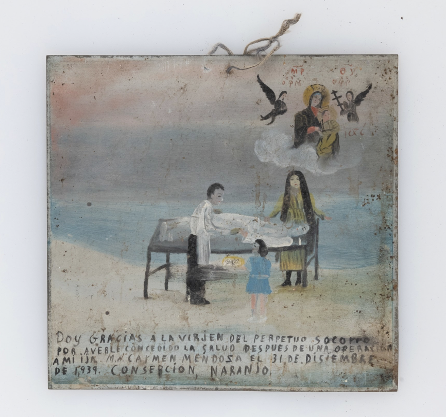
Fig. 2. Unknown artist, Ex-Voto: Nuestra Señora del Perpetuo Socorro (Our Lady of Perpetual Help), 1939. Oil on tin, 17.78 × 17.78 cm. Mexican Retablo Collection, New Mexico State University, inv. 1966.05.125.
A compelling example is Ex-Voto: Nuestra Señora del Perpetuo Socorro (Our Lady of Perpetual Help), painted in oil on tin by an unknown artist in 1939 (fig. 2).[46] Small in scale, the work depicts a liminal scene of medical recovery. The background is rendered in gradients of pink, grey, blue, and beige, loosely suggesting sky and water, though without any clear details. This hazy setting creates a sense of ambiguity, not fully tied to a specific place. At the center of the composition, a hospital bed dominates the foreground. A woman lies upon it, her pale body accented only by small touches of pink on the lips and hands. Her eyes are closed, suggesting fragility. At the foot of the bed, a man in a white coat, likely a doctor, leans forward and touches her hand. To his right, closer to the woman’s head, a child in a bright blue dress stands looking up at him. Directly across from the child, on the opposite side of the bed, a woman in a yellow dress and long dark hair extends her arms outward, her posture conveying both supplication and thanks.
Above this earthly scene, the Virgin of Perpetual Help appears from within a cloud. She holds the Christ Child and is flanked by two angels. Red inscriptions are painted around their heads, marking their divine status. Positioned directly above the outstretched woman, the Virgin appears as the figure being called upon in prayer. Along the bottom edge runs a painted inscription. Translated into English, it reads: “I give thanks to the Virgin of Perpetual Help for having granted health after an operation to my daughter M. Carmen Mendoza on December 31, 1939. Concepción Naranjo.” The text identifies the reclining woman as Carmen Mendoza, while the dedicant of the retablo ex-voto is her mother, Concepción Naranjo. Through its union of image and text, the composition turns personal crisis and recovery into a painted act of gratitude, created not by a professional artist but by a devotee giving thanks.
Such retablo ex-votos are painted in a simplistic style, where distortions of scale and ambiguous settings are common. The physical and spiritual realms coexist within the same pictorial space, with the divine figure appearing alongside the human participants in the scene. This convergence of worldly and otherworldly, ordinary and extraordinary, secular and sacred, exemplifies how the marvellous real underlies these artistic practices. It reflects an acceptance of miracles not as metaphors or symbols, but as constitutive of lived realities.
Frida Kahlo
Seen against the interconnected currents of modernist and devotional art in Mexico, it is easy to see why Surrealists perceived visual affinities between Kahlo’s paintings and their own work: the flattened space, the juxtaposition of incongruous elements, and liminal settings all seemed familiar to them. Yet once one recognizes Kahlo’s deep engagement with Mexican devotional traditions and visual culture, her compositional and visual language is more clearly rooted in these vernacular sources than in Surrealist art or theory. What the Surrealists interpreted as dream and unconscious imagination are, in Kahlo’s case, expressions of a lived reality in which the marvellous and the everyday coincide. Their differing readings of the same imagery recall what Viveiros de Castro describes as “a single view of different worlds”: they encountered the same forms, but those forms belonged to distinct ontological orders.[47]
Frida Kahlo’s paintings exemplify how the marvellous real takes shape through lived experience. Like the painters of retablo ex-votos, she transformed moments of crisis, pain, and endurance into visual accounts of her reality. Her engagement with arte popular was not imitative but deeply informed. Kahlo and Rivera collected hundreds of retablo ex-votos, most of them twentieth-century works.[48] Around 1932, she began painting on metal sheets herself, producing more than twenty works in this format.[49] As Bermeo observes, retablo ex-votos shaped her practice more than any other form of arte popular, though her paintings that most resemble them often function quite differently.[50]
Earlier, Henry Ford Hospital showed how Kahlo translated the experience of miscarriage into a testimonial image set within an industrial landscape. Seen now alongside retablo ex-votos, it also reveals how she borrows their structure to record suffering rather than a miraculous deliverance. As Hayden Herrera observes, the painting is “clearly modeled on Mexican votive paintings in style, subject, and scale,” yet Kahlo replaces the sacred figure and written thanksgiving with the stark reality of her own body and loss.[51]
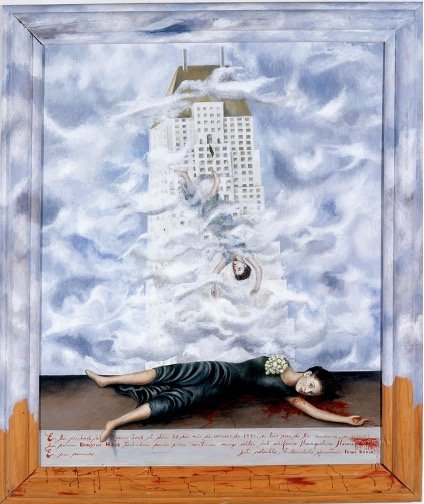
Fig. 3. Frida Kahlo, The Suicide of Dorothy Hale, 1939. Oil on Masonite, 60.4 × 48.6 cm. Phoenix Art Museum, Phoenix, Arizona.
Among the twenty-two works that Kahlo painted using the techniques and materials of the retablo ex-voto, this engagement culminates in The Suicide of Dorothy Hale, where she transformed the votive form into a meditation on mortality (fig. 3).[52] Commissioned by Clare Boothe Luce as a memorial portrait, the painting depicts Dorothy Hale’s death in three successive moments: at the top, she leaps from the window of her New York apartment; in the middle, her body plummets through the air, framed by drifting clouds; and at the bottom, she lies lifeless on the pavement. The tripartite structure resembles the narrative panels of a devotional image, yet here the miracle is inverted—salvation is replaced by irrevocable fall. The vertical composition pulls the viewer’s eye downward, from descent to impact, creating a sense of inevitability. Hale’s figure, rendered with porcelain smoothness, evokes the stillness of a doll. Beneath her, an inscription written in blood-red paint declares, “Frida Kahlo executed this retablo.” The inscription’s visceral colour makes it appear as though written in blood, fusing the painted world with Kahlo’s own presence and blurring the boundary between depiction and act. As Bermeo observes, the work “dramatically departs from ex-votos or retablos, paintings that commemorate salvation. Here, Hale does not survive.”[53] By appropriating the language of thanksgiving to narrate a death, Kahlo turns devotion toward the inevitability of loss, treating death not as rupture but as part of the continuum of being. In his introduction to The Diary of Frida Kahlo, writer Carlos Fuentes captures this sensibility: “Our difference from the European conceptions of death as finality is that we see death as origin. We descend from death. We are all children of death. Without the dead, we would not be here, we would not be alive. Death is our companion.”[54] This reflection situates Kahlo’s vision within a worldview where death is not an end but an ever-present force within life itself. The suspended body, the pale sky, and the faint shadow of Hale’s foot touching the inscription come together to transform violence into stillness and horror into contemplation. Here, the marvellous arises not from transcendence but from the unflinching clarity with which Kahlo renders death itself real.
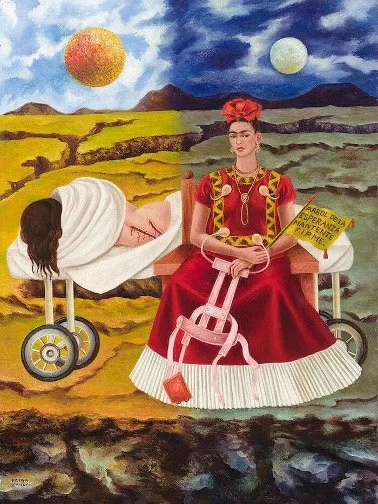
Fig. 4. Frida Kahlo, Tree of Hope, Remain Strong, 1946. Oil on Masonite, 55.9 × 40.6 cm. Daniel Filipacchi Collection, Paris, France.
Moving beyond retablo ex-voto imagery, Kahlo’s œuvre continued to embody the marvellous real, especially in her representation of bodily experience and pain. This is powerfully evident in Tree of Hope, Remain Strong, a painting that visualizes recovery as both endurance and painful (fig. 4).[55] Created after one of her many spinal surgeries, it captures her oscillation between hope for healing and despair at continued suffering. The composition is divided between night and day, darkness and light, earth and sky—yet these opposites coexist within the same continuous space. At the center, two versions of Kahlo appear: to the left, she lies on a hospital stretcher, her back marked by surgical wounds; to the right, she sits upright, clothed in a vivid red Tehuana dress, holding a surgical brace in one hand and a banner inscribed “Tree of Hope, Remain Strong” in the other. The sun and moon share the same sky, a dual motif that, as Hayden Herrera notes, unites “cosmic and terrestrial forces” and evokes Mexico’s preoccupation with duality.[56] Kahlo’s body becomes the site where these forces converge, where pain and persistence, night and day, death and life are made simultaneous. Although deeply personal, the scene draws on a broader Mexican sensibility in which suffering and vitality coexist. The painting is not a dream but a confrontation with reality, a vision of the marvellous as it endures within the wounded body, insisting that what is most painful can also be most real.
Kahlo’s paintings reveal how the marvellous real can take shape through the intimate and the bodily, translating personal experience into a vision of reality that holds pain and wonder together. Her work demonstrates that the marvellous need not depend on divine intervention or the unconscious but can emerge from the material and emotional conditions of everyday life. María Izquierdo approached this condition from another direction. While Kahlo painted the endurance of pain, Izquierdo painted its anticipation. Her work captures the moment before suffering becomes real, the instant when vision turns prophetic. In Dream and Premonition, Izquierdo transforms a dream into a premonition, revealing how the marvellous can manifest not only through miracle or endurance already lived but through the foreknowledge of what is to come.[57]
María Izquierdo
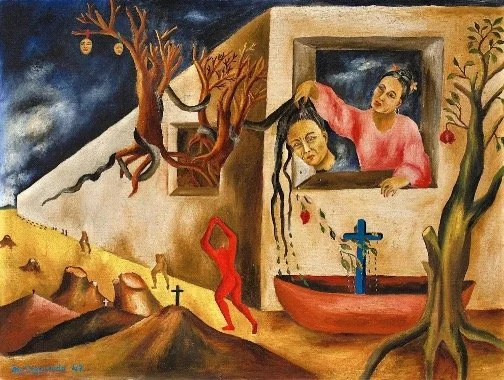
Fig. 5. María Izquierdo, Dream and Premonition, 1947. Oil on canvas. Ma. Esthela E. de Santos Collection, Monterrey, Mexico.
In Dream and Premonition, the marvellous real arises not from the dream as metaphor but from the dream as lived experience (fig. 5). The painting, based on a dream Izquierdo had, shows her doubled at the window: one María leans outward, holding her own severed head by the hair. The head’s eyes are open, its face marked by a sadness that is steady rather than dramatic. From it fall tears mixed with leaves that drift into a small red boat below, where a blue cross rises and the fallen leaves gather around it. The severed head’s hair tangles with the branches of three nearby trees that seem to come from another window of the same structure, with two branches bearing two small hanging heads. Below, what can be assumed to be Izquierdo’s headless body, painted in vivid red, walks away across a sloping yellow ground, arms raised as if reaching to grasp her intact self. Ahead of it, other headless figures walk into the distance, each losing parts of their bodies until only a pair of feet remains at the horizon. To the left, the terrain swells into mounds and stumps marked with crosses, while to the right, a tree bears a single wilted rose. A dark storm gathers above and within the structure, visible through its windows, the swirling greys and deep blues pressing against the scene with a heavy, foreboding stillness. The structure’s sharp diagonals lead the eye from the two Marías at the window along the procession of disappearing bodies toward the horizon. The head’s restrained sorrow anchors the scene’s intensity. A few months after completing the work, Izquierdo suffered a hemiplegia that left the right side of her body paralyzed and her speech impaired—an uncanny echo of the vision she had painted.[58] In retrospect, the image reads not as fantasy but as foresight, where a vision is taken as real. Through this act of self-vision, Izquierdo rendered the marvellous as a truth that unfolds through time, turning prophecy itself into a form of reality.
What distinguishes Izquierdo’s vision is its treatment of time. The dream does not simply prefigure an event; it brings that event into being. Within the painting, future and present coexist, collapsing temporal distance much as retablo ex-votos collapse heaven and earth. If, as Fabian argues, anthropology and related discourses have often enacted a “denial of coevalness” by pushing others into another time, Izquierdo’s painting refuses that logic. The suffering to come appears as already present, insisting on the simultaneity of vision and event. The marvellous real, in this sense, is not a retrospective recognition of wonder but its anticipation—a reality that declares itself before it occurs. In this sense, Dream and Premonition resonates with Kahlo’s Tree of Hope, Remain Strong, though it moves in the opposite temporal direction. Kahlo painted recovery after trauma, while Izquierdo foresaw it. Both transform suffering into revelation and locate the marvellous in the image’s capacity to act—to foresee, to affirm, and to make real what is felt.
Conclusion
Read through a reimagined sense of the marvellous real, these twentieth-century Mexican artworks show how the extraordinary operates within lived experience rather than as fantasy or metaphor. Retablo ex-votos, together with works by Frida Kahlo and María Izquierdo, give form to realities in which devotion, pain, and revelation belong to everyday life. Taken together, they reveal the marvellous not as an addition to the real, but as one of its enduring conditions.
The analyses also exposed both the value and the limitations of inherited art-historical categories. Surrealism offered a language for the unfamiliar and helped bring Mexican artists to international attention, yet it redirected interpretation toward the unconscious, obscuring how Kahlo and Izquierdo grounded their imagery in lived experience and local cosmologies. Primitivism and folk art introduced related distortions: they linked artistic value to temporal distance and racialized ideas of origin, praising “naïve” sincerity and tradition while relegating popular and devotional art to a symbolic past. In doing so, these discourses enact a “denial of coevalness,” as if reflection and intention did not fully belong to the practices they describe. These categories can be seen to have defined the boundaries of modernism and, in doing so, constrained what counts as real. Reframed through Carpentier’s notion of the marvellous real, these same works appear differently. What once seemed timeless, dreamlike, or primitive emerges instead as grounded in lived worlds where the marvellous and the real coexist.
Yet Carpentier’s vision remains a starting point rather than an endpoint. His marvellous depended on belief as the condition for the extraordinary to take place, and it posited a singular marvellous real for “the Americas.” Read through anthropology’s ontological turn, however, the marvellous real becomes plural and operative: it no longer relies on faith but on effect—on what images and practices do in the world. Retablo ex-votos give thanks and sustain relations, Kahlo’s paintings make suffering visible and enduring, and Izquierdo’s dream becomes real through its unfolding in time. Together they reveal not one marvellous real but many coexisting realities, each made tangible through artistic form.
The marvellous real, reconsidered through an ontological framework, thus stands less as a theory than as a method of attention. It invites the viewer to ask where an image claims reality, how that claim is made, and what forms of relation it sustains. This perspective shifts the focus away from rigid categories toward the relations images create and the kinds of worlds they presuppose. Reading Kahlo, Izquierdo, and the makers of retablo ex-votos together shows how the marvellous arises from what is lived, felt, and seen. Their works do not dissolve the boundary between art and life; they show that it was never fixed to begin with, and that the marvellous endures through images that make lived experience visible as real.
Endnotes
[1] Alejo Carpentier, “The Baroque and the Marvelous Real,” in Magical Realism: Theory, History, Community, ed. Lois Parkinson Zamora and Wendy B. Faris (Durham, NC: Duke University Press, 1995), 101.
Throughout this essay, I use the Canadian spelling “marvellous.” Quoted sources retain their original spelling.
[2] Alejo Carpentier, “Prologue to the Kingdom of This World (1949),” Review: Literature and Arts of the Americas 26, no. 47 (1993): 28, https://doi.org/10.1080/08905769308594357.
[3] Carpentier, “Prologue to the Kingdom of This World,” 28.
[4] Carpentier, “Prologue to the Kingdom of This World,” 31.
[5] Carpentier, “Prologue to the Kingdom of This World,” 28.
[6] Carpentier, “Prologue to the Kingdom of This World,” 29.
[7] Carpentier, “Prologue to the Kingdom of This World,” 29.
[8] Carpentier, “Prologue to the Kingdom of This World,” 31.
[9] Alejo Carpentier, “On the Marvelous Real in America,” in Magical Realism: Theory, History, Community, ed. Lois Parkinson Zamora and Wendy B. Faris (Durham, NC: Duke University Press, 1995), 75.
[10] Carpentier, “On the Marvelous Real in America,” 75.
[11] Alejo Carpentier, “The Baroque and the Marvelous Real,” in Magical Realism: Theory, History, Community, ed. Lois Parkinson Zamora and Wendy B. Faris (Durham, NC: Duke University Press, 1995), 101.
[12] Carpentier, “The Baroque and the Marvelous Real,” 95.
[13] Walter D. Mignolo, Local Histories/Global Designs: Coloniality, Subaltern Knowledges, and Border Thinking (Princeton, NJ: Princeton University Press, 2012), ix.
[14] Mignolo, Local Histories/Global Designs, xvi.
[15] Franz Roh, “Magic Realism: Post-Expressionism,” in Magical Realism: Theory, History, Community, ed. Lois Parkinson Zamora and Wendy B. Faris (Durham, NC: Duke University Press, 1995), 15.
[16] Lois Parkinson Zamora and Wendy B. Faris, “Introduction: Daiquiri Birds and Flaubertian Parrot(ie)s,” in Magical Realism: Theory, History, Community, ed. Lois Parkinson Zamora and Wendy B. Faris (Durham, NC: Duke University Press, 1995), 3.
[17] Zamora and Faris, “Introduction,” 3.
[18] Whitney Chadwick, Women Artists and the Surrealist Movement (London, UK: Thames & Hudson, 2024), 109.
[19] Hayden Herrera, Frida: A Biography of Frida Kahlo (New York, NY: Harper & Row, 1983), 292.
[20] Herrera, Frida, 252.
[21] Herrera, Frida, 302.
[22] Frida Kahlo, Henry Ford Hospital, 1932, oil on metal, 30.5 × 38 cm, Museo Dolores Olmedo, Xochimilco, Mexico City, fig. 1.
[23] Johannes Fabian, Time and the Other: How Anthropology Makes Its Object (New York, NY: Columbia University Press, 1983), xi.
[24] Fabian, Time and the Other, 31.
[25] Fabian, Time and the Other, 95.
[26] Fabian, Time and the Other, 63.
[27] Nancy Deffebach, María Izquierdo and Frida Kahlo: Challenging Visions in Modern Mexican Art (Austin, TX: University of Texas Press, 2015), 26.
[28] Deffebach, María Izquierdo and Frida Kahlo, 26.
[29] Deffebach, María Izquierdo and Frida Kahlo, 18.
[30] Elizabeth Ferrer, The True Poetry: The Art of María Izquierdo (New York, NY: Americas Society, 1997), 54.
[31]Twenty Centuries of Mexican Art (New York, NY: Museum of Modern Art and the Instituto de Antropología e Historia de México, 1940), 110.
[32]Twenty Centuries of Mexican Art, 110.
[33] Layla Bermeo, Frida Kahlo and Arte Popular (Boston, MA: MFA Publications | Museum of Fine Arts, Boston, 2022), 20.
[34] Bermeo, Frida Kahlo and Arte Popular, 80.
[35] Bermeo, Frida Kahlo and Arte Popular, 19.
[36] Martin Holbraad and Morten Axel Pedersen, The Ontological Turn: An Anthropological Exposition (Cambridge, UK: Cambridge University Press, 2019), 163.
[37] Holbraad and Pedersen, The Ontological Turn, 6.
[38] Elizabeth Netto Calil Zarur and Charles Muir Lovell, eds., Art and Faith in Mexico: The Nineteenth-Century Retablo Tradition (Albuquerque, NM: University of New Mexico Press, 2001), 18.
[39] Zarur and Lovell, Art and Faith in Mexico, 18.
[40] Zarur and Lovell, Art and Faith in Mexico, 18.
[41] Zarur and Lovell, Art and Faith in Mexico, 19.
[42] Zarur and Lovell, Art and Faith in Mexico, 19.
[43] Gloria Fraser Giffords, Mexican Folk Retablos (Albuquerque, NM: University of New Mexico Press, 1992), 2.
[44] Giffords, Mexican Folk Retablos, 145.
[45] Giffords, Mexican Folk Retablos, 143.
[46] Unknown artist, Ex-Voto: Nuestra Señora del Perpetuo Socorro (Our Lady of Perpetual Help), 1939, oil on tin, 17.78 × 17.78 cm, Mexican Retablo Collection, New Mexico State University, inv. 1966.05.125, fig. 2.
[47] Holbraad and Pedersen, The Ontological Turn, 163.
[48] Bermeo, Frida Kahlo and Arte Popular, 65.
[49] Bermeo, Frida Kahlo and Arte Popular, 17.
[50] Bermeo, Frida Kahlo and Arte Popular, 72.
[51] Herrera, Frida, 151.
[52] Frida Kahlo, The Suicide of Dorothy Hale, 1939, oil on Masonite, 60.4 × 48.6 cm, Phoenix Art Museum, Phoenix, Arizona, fig. 3.
[53] Bermeo, Frida Kahlo and Arte Popular, 75.
[54] Carlos Fuentes, introduction to The Diary of Frida Kahlo: An Intimate Self-Portrait, by Frida Kahlo, ed. Sarah M. Lowe (New York, NY: Abrams, 2005), 23.
[55] Frida Kahlo, Tree of Hope, Remain Strong, 1946, oil on Masonite, 55.9 × 40.6 cm, Daniel Filipacchi Collection, Paris, France, fig. 4.
[56] Herrera, Frida, 152.
[57] María Izquierdo, Dream and Premonition, 1947, oil on canvas, Ma. Esthela E. de Santos Collection, Monterrey, Mexico, fig. 5.
[58] Elizabeth Ferrer, The True Poetry: The Art of María Izquierdo (New York, NY: Americas Society, 1997), 28.